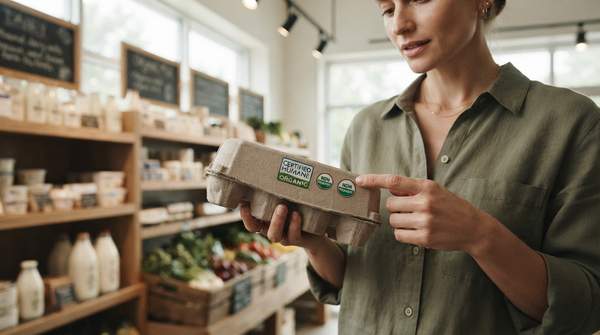
Some food labels are backed by law, audits, and accredited certifiers. Others are just words on a package. The difference matters: if you want your purchases to reflect your values on animal welfare, fair labor, or environmental impact, the single most useful habit is looking for a third-party certification seal and knowing what each seal actually guarantees. Terms like "natural," by contrast, carry no regulated standard at all.
Decoding Ethical and Sustainable Food Labels
Food packaging is dense with claims—nutrition facts, health claims, logos, and proclamations about how animals were treated. As the food-systems nonprofit FoodPrint puts it, "not all labels are created equal." Some, such as USDA Organic Certification or Animal Welfare Approved, are clear indications that the food has been certified to meet specific requirements. Others, like "Pasture Raised," merely suggest certain practices were used without guaranteeing them. And sometimes the words themselves—in the case of "natural"—have ceased to have any true meaning. This guide, focused on the U.S. market, sorts the meaningful from the decorative.
Understanding the Landscape of Food Certifications
The key dividing line is verification. The word "organic," for example, isn't just marketing fluff: it's a legal certification regulated by the U.S. Department of Agriculture's National Organic Program. Behind every legitimate organic label, as the accredited certifier CCOF explains, sits paperwork, inspections, and oversight by an accredited certifying body. That is what separates a certification from a claim: someone independent checks the farm or facility against written standards, on a defined schedule.
Unregulated marketing terms operate under no such system. There is no certifier, no inspection cycle, and no standard document you could consult to learn what the producer actually did. Recognizing which side of that line a label falls on is the foundation for everything that follows—and it's why two seals sitting side by side on a shelf can represent entirely different levels of accountability.
Comparative Guide to Ethical and Sustainable Food Labels
Use this table to classify a claim at a glance: which labels are third-party certified, which are regulated but tiered, and which carry no verifiable standard at all. The comparison is built from what each certifier's own documentation says its label means, who performs the verification, and where the gaps lie.
| Label / Claim | Meaning / Standard | Verified By | Key Limitation / Watch-out |
|---|---|---|---|
| USDA Organic (seal, 95% or more) | At least 95% certified organic ingredients; the remaining 5% must come from the USDA's National List of Allowed Substances. | USDA National Organic Program, with accredited certifiers such as CCOF performing inspections and oversight. | Tiered system—confusingly similar labels mean different things. |
| "Made with Organic [ingredients]" | 70–94% organic ingredients; may list up to three organic ingredients or food groups. | Same NOP framework and accredited certifier oversight. | Cannot display the USDA seal, though the certifier's logo may appear. |
| Animal Welfare Approved (by AGW) | Rigorous standards for farm animal welfare and environmental sustainability, developed with scientists, veterinarians, researchers, and farmers; covers major farmed livestock and poultry, including beef and dairy cows, pigs, poultry, sheep, goats, and bison. | A Greener World, through annual re-certification audits with a maximum of 18 months between inspections. | Standards are set by the certifier itself—check the seal matches the AGW program. |
| Fair Trade Certified | Social, environmental, and economic requirements that producers and businesses must meet; standards are tailored to specific products, production systems, and business activities. | Third-party certification through Fair Trade Certified, which verifies compliance with its published requirements. | Standards vary by industry and supply chain, so coverage differs product to product. |
| "Natural" | No regulated definition—widely described as marketing language rather than a certification. | Nobody. | Lacks specific, verifiable standards; unlike "organic," it is not a legal certification. |
| "Pasture Raised" | Implies certain practices were used, but per FoodPrint's label guide it does not guarantee they were met. | No specific, verifiable standard or third-party certification is established for this term. | May function as a marketing claim; without clear standards, treat with caution. |
The pattern is the takeaway: verified labels can tell you who audits, against what standard, and how often. "Natural" and "Pasture Raised" cannot answer any of those questions.