AI in art is far more than typing a prompt and receiving a picture. Drawing on expert commentary and documented artistic practice, the technology operates across four distinct modes — generative, interactive, analytical, and assistive — and the difference between them lies less in the software than in how the artist works with it. Some AI produces finished content in a single transaction; other AI responds to audiences, visualizes data, or quietly streamlines technical labor while the artist keeps every meaningful decision.
Beyond Prompts: Understanding AI's Diverse Roles in Art
The public image of AI art was shaped by text-to-image tools: type a description, wait a minute, receive an image. That workflow, as one venture critique of creative AI tools observes, delivers "an immediate dopamine hit" but locks the artist into what its author calls a one-off transaction rather than a creative process. Real art-making, the same critique argues, "is dialectical; a dialogue between the creator and the medium."
That critique is a useful starting point, because plenty of contemporary practice already escapes the prompt-and-receive trap. The Interaction Design Foundation traces an evolution in which AI first served purely as a tool aiding the creative process, and generative models have since taken on a more autonomous role in creating artworks — a shift it describes as marking a paradigm change in how we perceive the boundary between human creativity and machine intelligence. Syracuse University computer art professor Rebecca Xu frames the technology plainly: AI is another tool artists are embracing, one her own research explores across artistic data visualization, visual music, digital performance, and interactive installations.
AI as a Generative Partner: Creating New Artistic Content
Generative AI is defined by its ability to create new content — images, sound, video — often from a prompt or a dataset. In its simplest commercial form this is exactly the one-shot workflow critics dislike. But at the highest level of practice, generation becomes something else entirely.
Media artist Refik Anadol, interviewed by WIPO Magazine, describes his generative work as a genuinely human-machine collaboration with a multidisciplinary team of architects, designers, AI engineers, data scientists, musicians, philosophers and neuroscientists. Asked what level of control he holds, Anadol answers: "I'm hands-on. I'm involved in setting every single parameter. That is how I maintain a connection with my work and make it my own." For some works, his team collaborates with institutions such as NASA's Jet Propulsion Laboratory and the Museum of Modern Art to source datasets. The generative model is not the author; it is the instrument Anadol tunes.
AI as an Interactive Medium: Art That Responds and Evolves
In interactive installations, AI stops being a production tool and becomes part of the artwork's nervous system. As one practitioner writing on responsive installations explains, AI installations can observe viewer behavior and respond in real-time, "creating experiences that are genuinely unique for each person." The underlying stack, this artist notes, is a mashup of computer vision tracking movement, machine learning models interpreting that data, and generative systems producing the content.
The clearest documented example is Anadol's Unsupervised, exhibited at MoMA. According to the museum, Anadol incorporates site-specific input from the Gund Lobby environment — changes in light, movement, acoustics, and the weather outside — to continuously affect the shifting imagery and sound. MoMA contrasts this with AI's typical use in classifying and generating realistic representations, calling Unsupervised an exploration of "fantasy, hallucination, and irrationality."
Another example is ReCollection (2022–2024) by Weidi Zhang and Rodger Luo, an interactive AI installation that assembles synthetic collective memories from participants' input. A published analysis of the work describes its design as a form of pseudo-real-time interaction, with system delay incorporated into a continuous visual transition between successive participants' generated memories — the artwork literally evolves from person to person.
AI for Analytical Insight: Visualizing Data as Art
A quieter but growing role is analytical: using AI to process and visualize complex data as an art form. Rebecca Xu's research at Syracuse focuses specifically on how emerging technologies, particularly AI, can enhance the creative process for artistic data visualization alongside visual music and digital performance. Her animated work Péripéties: Fragile Sovereignties, built through experiments with generative programming and AI, has been featured in national and international exhibitions.
Anadol's practice bridges this category and the generative one. His stated ambition — "to translate the new language of humanity, as expressed by data, into art forms" — treats datasets from institutions like NASA JPL not as raw material to be copied but as a substrate for aesthetic interpretation. In analytical mode, the artist's contribution is the frame: which data matters, what it means, and how meaning becomes visible.
AI as an Assistive Tool: Streamlining the Creative Process
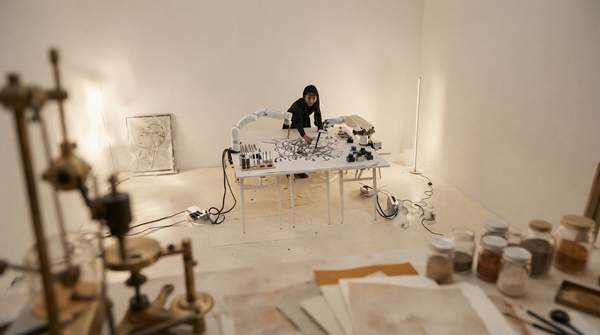
The least glamorous mode may be the most widespread: AI as an assistant that automates mundane tasks so artists can focus on creative work. NYU's professional studies school highlights this in its guidance on AI and creativity, noting that AI can analyze vast amounts of data and generate unique concepts that might inspire an artist's next work, while automating tasks that would otherwise drain time from the artistic journey.
Assistive use covers ideation, concept development, and technical preparation before the real work begins. The distinction from generative use matters: here AI output is never the artwork. It is scaffolding — a mood board that talks back, a rough draft of possibilities the artist accepts, rejects, or reworks. The same NYU guidance is explicit that AI-generated content should serve as a foundation, which the artist then infuses with unique style, emotions, and personal narrative.
Maintaining Creative Control: The Artist's Iterative Dialogue with AI
The recurring worry — that AI replaces the artist — dissolves once you look at how sophisticated practitioners actually work. The venture critique of current tools argues that "real creative processes are non-linear; they move through revision and reversal," and laments that with prompt-only tools "there's no way to refine the work — just the dull ritual of tweaking the prompt and hoping the good parts survive." Artists who treat AI as a medium rather than a vending machine escape precisely that trap.
The evidence suggests two distinguishable postures. The transactional posture: prompt, receive, done. The dialogical posture: what Anadol models — setting every parameter, remaining hands-on, treating the system's output as one turn in an ongoing conversation. The critique itself points to the same path, praising artists who use AI "to create art that embraces the limitations of its medium," or who leverage it to make work that still requires human intervention yet is fundamentally different from what came before. Creative control is not lost to the tool; it is exercised through the choice of workflow.
AI's Collaborative Spectrum in Art
The four modes above can be turned into a diagnostic framework. The categorization is a synthesis of the applications described by these sources rather than a model any single source formally proposes, but each cell is grounded in documented practice. To classify any AI artwork or practice you encounter, identify the artist's mode of interaction and their level of control:
| Mode | Artist interaction | Documented example | Where control lives |
|---|---|---|---|
| Generative | AI creates new content from prompts, parameters, or datasets | Refik Anadol's data-driven works, made with datasets from NASA JPL and MoMA | In parameter-setting — Anadol describes himself as "hands-on" on "every single parameter" |
| Interactive | AI observes viewers or environment and responds in real-time | Anadol's Unsupervised at MoMA, fed by lobby light, movement, acoustics and weather; Zhang and Luo's ReCollection (2022–2024) | In system design — the artist scripts what the artwork senses and how it reacts |
| Analytical | AI processes and visualizes complex data as art | Rebecca Xu's research in AI-enhanced artistic data visualization, including Péripéties: Fragile Sovereignties | In framing — choosing which data to render and what it should mean |
| Assistive | AI automates tasks and generates concepts; output is never final | NYU's guidance on using AI for inspiration and idea generation | Entirely with the artist — AI content is a foundation to be infused with personal style and narrative |
Using the framework is straightforward: ask what the AI's output becomes. If it is the artwork, the case is generative. If it changes when a viewer walks past, it is interactive. If the artwork's subject is data itself, it is analytical. If the output would be discarded or transformed before exhibition, the use was assistive.
Embracing AI as a Creative Partner
Artists should explore AI tools not merely as prompt-based generators, but as versatile partners for generative, interactive, analytical, and assistive tasks, actively engaging in an iterative dialogue to maintain creative control. The choice among these modes is itself a creative decision, and the evidence suggests the most compelling work comes from artists who treat the system as a medium with limitations to embrace rather than a slot machine to pull.
A simple test separates the approaches in the wild: observe how artists describe their interaction with AI — whether they emphasize iterative refinement and parameter control, or simply "prompting" and receiving output. When an artist can tell you which parameters they set, which data they chose, and what they revised, you are looking at a collaboration. When the description stops at the prompt, you are looking at a transaction.
Sources
- Where's the creativity in creative AI tools? — Amplify Partners — Amplifypartners
- What Is AI-Generated Art? — updated 2026 — IxDF - Interaction Design Foundation
- How Artists Are Embracing Artificial Intelligence to Create Works of Art — Syracuse University Today
- ‘Painting’ with Data: How Media Artist Refik Anadol Creates Art Using Generative AI — WIPO
- MEDIUM
- MOMA
- MDPI
- Embracing Creativity: How AI Can Enhance the Creative Process — SPS