Community-engaged art events are defined not by free entry or a friendly tone, but by who shapes the work and what it is for. At one end sits participatory art, where the artist keeps the vision but the audience activates it; at the other, public art, which reaches people in shared spaces but rarely involves them in the making. Genuine community art sits in between: a specific community drives the vision, and the creative process is the point. This guide breaks those models into a usable framework, offers a checklist of telltale activities and venues, and tests the ideas against a real case — the Austin Studio Tour, whose open-studio model this year spans 309 locations.
Framework for Identifying Community-Engaged Art Events
The clearest way to tell these categories apart is to compare three dimensions: what the art is primarily for, what the audience actually does, and where it happens. Artist Anna Masters, writing on the distinctions between participatory, community and public art, notes that participatory and performative works are "activated through the actions and interventions of the audience," while the "overall vision and conceptual drive comes from the artist" — and that they are usually, though not always, set in an artistic or gallery context.
| Model | Primary goal | Role of audience | Typical setting |
|---|---|---|---|
| Participatory Art | Activate the artwork through audience action, within the artist's vision | Acts and intervenes; involvement is essential for the work to be realized | Usually an artistic or gallery context, though not always |
| Community Art | Shift focus from artistic output to the collective voice and communal creative experience | Drives the content; the community's input is central to creation and meaning | Created in and for the community it serves, in locally accessible settings |
| Public Art | Reach audiences in shared public spaces | Primarily views the work; engagement is observational | Public spaces, sometimes with attention to impact on the space and community |
Masters adds a useful caution from her own workshop-based practice: community art projects can take any form, "from murals to festivals," but are usually designed to reflect the specific communities and locations they serve, and the focus tends to be community benefit rather than artistic outcome — though, as she puts it, "it could very easily be argued that the community benefit is the artistic outcome." Her own project, Ad Memoriam Charcoals, illustrates the dynamic: she guided the theme, process and format, but the output would not have existed without the participants.
Public art, she cautions, is a different beast. It has long reached audiences beyond the traditional gallery-going public, but it only sometimes concerns itself with the impact of the artwork on the space and community it inhabits. That qualifier matters for festivalgoers: an outdoor sculpture show may be free and centrally located without being community-engaged in any meaningful sense.
Characteristics of Community-Engaged Art Events: A Practical Checklist
To translate the framework into something you can use at a local event, the clearest inventory of participatory settings and activities comes from MIT's Engaging Community resource on arts and engagement. It lists both the venues where participatory work tends to live and the activities that define it. The venues skew deliberately unglamorous: street fairs and festivals, public schools, libraries, parks, plazas, malls, recreation and community centers, community gardens, churches, and informal gallery spaces for local artists such as coffee shops, cafes and night clubs.
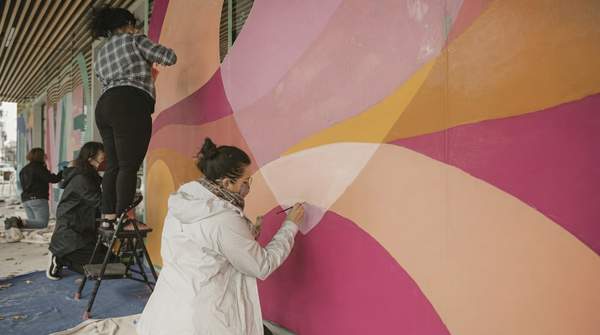
The activities are the stronger signal. MIT's list includes classes and rehearsals of all kinds, performances and recitals, community-curated museum exhibits, artist-plus-community collaborations such as murals and mosaics, urban design community workshops, interactive sculpture and installations in public spaces, public canvases like chalkboards, graffiti walls and open mics, craft fairs, poetry slams, flash mobs, and environmental art.
The pattern across both lists is worth naming: nearly every activity requires the audience to do something — select, build, recite, design — rather than merely attend. When you scan a festival program, look for verbs that could not happen without you. A lineup of performances you watch in a park is closer to public art; a schedule of workshops, open mics and co-created murals is participatory, and if the participants are locals shaping content about their own place, it tips into community art territory.
Austin Studio Tour: An Open Studio Model for Community Connection
The Austin Studio Tour, now in its 24th year, shows what a community-engaged model looks like at scale. As KEYE's "We Are Austin" segment reported, the 2026 tour invites the community to explore artists' studios, galleries and creative spaces across the city during two weekends in November, with — per participant Natalie Earhart — 815 participants across 309 locations and free admission.
Structurally, this is an open-studio model: rather than filtering work through a gallery, the city's creative spaces open their doors and residents move through their own neighborhoods. The tour's website lets users filter by location, art form and activities, and organizers have built curated routes, including family-friendly options, accessible experiences and paths for music lovers.
Why count this as community engagement rather than a giant self-guided exhibition? Research on festivals and placemaking, published in a study on arts festivals and community, argues that festivals should not be considered utopian, elitist or exclusive, but instead seen "as a key to unlocking community assets," especially when they are designed to bring local communities together in open, accessible spaces within the locality. Festivals, the research argues, produce and liberate creative spaces that animate those assets, "allowing the community to perceive of itself and the available spaces differently."
That is a fair description of what an open-studio tour does: it converts garages, studios and coffee shops into visible creative infrastructure, and lets residents encounter artists as neighbors rather than as names on a label. In the framework's terms, the Austin Studio Tour is participatory — the visitor's exploration is what activates the event — with community emphasis coming from its location-driven, neighborhood-scale structure rather than from co-created works.
How to Spot Truly Community-Engaged Art Events
To identify truly community-engaged art events, look for events that explicitly involve the community in creation, reflect local identity, and offer interactive activities beyond passive viewing. The measurable indicator is concrete: the presence of community-curated exhibits, collaborative mural projects, workshops, or open studio models.
Apply the three tests in order. First, check the audience's role in the program description: does anyone besides the featured artists make, choose or shape anything? Second, check the setting: is the work made in and about this specific place, in venues locals already use — parks, libraries, community centers, informal galleries? Third, check the framing: does the organizer talk about local connection and what participants take away, or only about what will be on view?
The Austin Studio Tour passes on all three counts for its model — free, self-directed, neighborhood-based, with 309 locations to explore — and the checklist items from MIT's participatory-arts inventory, from poetry slams to community-curated exhibits, give you a vocabulary for vetting whatever festival arrives next in your own city.