The core principle of interactive storytelling in digital art is simple to state and rich in consequence: the artist designs a system that perceives what the audience does, and the story changes accordingly. Every interactive installation, from a floor projection that blooms under footsteps to an artificial intelligence that learns a visitor's habits, is built on the same three-part machinery — audience input, a technological mediator, and narrative output. What separates shallow interactivity from genuine narrative collaboration is where the work places you on a spectrum of agency: are you merely a trigger for a pre-programmed effect, or a co-author of a story that could not exist without you?
Understanding Interactive Storytelling in Digital Art
Traditional storytelling asks an audience to receive a finished narrative. Interactive digital installations invert that contract. As Technarte's overview of the form puts it, these are artworks "capable of responding to the presence and actions of the audience in real time," using sensors, cameras, tracking systems, or artificial intelligence to detect what is happening around them and modify the behavior of the work. The East End Arts Council, discussing visual storytelling techniques, describes the same shift: installations immerse the viewer and transform storytelling into an experiential journey, while interactive digital pieces allow viewers to navigate the story in nonlinear ways. The audience is no longer reading or watching a story; it is inside the mechanism that produces one.
The Interaction Model: Audience, Technology, and Narrative
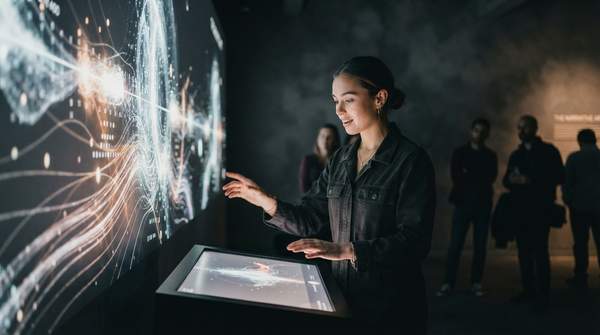
Once you look closely, every interactive installation runs on the same causal chain. First, a person does something — moves, touches, speaks, chooses, or simply stands present. Second, the system perceives that action through hardware and interprets it through software. Third, the artwork responds, and that response is where the narrative lives: a projection transforms, a sound shifts, a path through the story opens or closes. Technarte describes exactly this loop, noting that a person's movement can transform a projection, activate elements, or alter the sound, lighting, or images of the installation. The framework below turns that loop into an analytical tool you can carry into any gallery.
The Interactive Storytelling Framework
This framework breaks any interactive installation into three components and then asks the decisive diagnostic question: how much agency does each component give the participant? The table maps the chain from your action to the story's change.
| Component | What it is | Typical mechanisms | Narrative effect |
|---|---|---|---|
| Audience Input | What the participant does, or their mere presence, that the installation detects | Physical engagement with objects, movement, choices affecting story paths, "choose your own adventure"-style decisions | Sets the raw material the story will be built from |
| Technological Mediator | The system that perceives and processes the input | Motion sensors, cameras, tracking systems, AI; software built in environments like Unity or Unreal, and in languages such as JavaScript, Python, and Processing | Determines how richly the work can interpret the participant |
| Narrative Output | The observable change in the artwork's behavior or the story's progression | Direct visual or sonic response; branching paths; evolving, personalized, or emergent story shaped by recognized patterns | Reveals whether you are a trigger or a co-creator |
Audience Input: Actions that Drive the Story
Input is whatever the work is built to notice. It can be deliberate — a choice between story branches, as in the interactive and gamified stories described in the University of York's digital creativity guide — or it can be involuntary: your body crossing a sensor's field is itself a narrative event. The York guide makes the useful point that digital stories "don't have to be linear and passive"; audiences can interact through choices or gamified elements. In installations, input also includes physical engagement with tangible elements, which the East End Arts Council identifies as a way of deepening narrative complexity. The breadth of accepted inputs is the artist's first big design decision.
Technological Mediators: Bridging Action and Narrative
The mediator is the invisible middle of the chain, and it has two layers. Hardware — motion sensors, cameras, tracking systems — detects what people do. Software interprets and responds. A worked example from projection-mapping software maker HeavyM illustrates the layering: a projector connected over HDMI to a Windows desktop computer, a depth-sensing tracking camera, and Augmenta tracking software, with artists integrating these components into a seamless interactive experience. These are not engineering details for their own sake; the mediator defines the vocabulary of the conversation. A work with a single motion sensor can only hear one sentence — "someone moved" — while an AI-driven system can recognize patterns in how people interact over time.
Narrative Output: How Stories Evolve
Output is where the audience finally sees the story move. The range is wide. At the simplest level, the output is a direct response: movement transforms a projection or alters sound and lighting, in Technarte's description of the form. The new media artist Steve Zafeiriou describes the more complex end: AI-driven installations can analyze audience behavior over time, recognize patterns, and let the artwork evolve in response — even personalizing the experience to a visitor's preferences, face, or voice, making each interaction unique. The Arts Management and Technology Laboratory adds a relational dimension: when audiences no longer worry about damaging a piece through interaction, the connection deepens, enabling personalized expression and immersive, memorable experiences.
From Spectator to Co-Creator: The Spectrum of Agency
The framework's most important yield is a diagnostic boundary between two modes of participation. Reactive participation means your input selects among outcomes the artist already authored — you trigger a pre-programmed effect or choose from existing paths. Co-creation means your actions generate a narrative that could not have been fully predicted: the story is emergent, shaped by accumulated audience behavior. An academic analysis of the audience-artwork relationship frames this as the field's central redefinition, examining "the empowerment of audiences as collaborators" and the shift from spectatorship to participation. Co-creation bridges the artist's vision and the participant's direct influence on the outcome; the story is a shared authorship that keeps evolving.
A writer on interactive storytelling captures the temporal consequence of this shift: such stories enter "a state of unfinish" — they never quite end, because the next participant can always move them again.
Analyzing Interactive Art: A New Lens for Appreciation
To fully appreciate interactive digital art, analyze the specific mechanisms of audience input, technological mediation, and narrative output to discern the degree of agency offered. In practice: when you next step into an installation, ask what the work is sensing, what software is doing with that signal, and whether the resulting change was clearly pre-authored or something the system composed in response to you. The measurable indicator is the artwork's responsiveness and the extent to which your actions genuinely shape an evolving narrative versus triggering pre-set outcomes. One installation will answer with a rehearsed effect; another will answer with a story you helped write — and knowing which is which is where real appreciation begins.
Sources
- Uxdesign
- Pioneerpublisher
- Interactive installations: definition and examples — Technarte
- Beyond Words: Visual Storytelling Techniques in Art — East End Arts Council | Long Island Art & Music Gallery
- Subject Guides: Digital Creativity: a Practical Guide: Interactive stories — Subjectguides
- Interactive art installation with sensors — HeavyM
- Artistic Futures: Digital Interactive Installations — Arts Management and Technology Lab