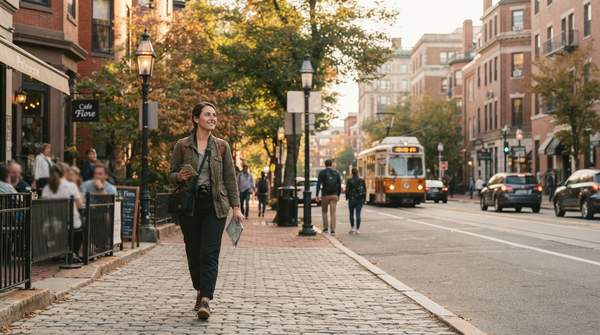
The best U.S. city for your solo trip is not necessarily the one with the most attractions—it is the one whose structure matches your comfort level for independent exploration. Travel safety guidance focused on solo travelers, particularly women, points to a consistent set of features that make a city easy and comfortable to navigate alone: a compact, walkable tourist core, reliable and affordable rideshare or transit, a culture where dining solo is normal, and the visible presence of other solo travelers. This article turns those features into a repeatable evaluation framework you can apply to any U.S. destination.
Introduction: Empowering Your Solo City Adventure
Rather than relying on a ranked "best of" list, you can make a more durable decision by assessing a city's structural safety profile before booking. This matters because, as one solo travel safety guide puts it, "Not every city that markets itself as solo-friendly actually delivers that on a Tuesday night."
The demand is real: according to that guide, citing Solo Traveler World, solo travel among Americans has grown steadily since 2022, and women now represent over 80% of solo travel inquiries on major booking platforms. The framework below is geared primarily toward solo female travelers, the perspective highlighted in the available expert advice, but any independent traveler can use it. It focuses on safety and navigation, not on specific attractions, restaurants, or hotels, and it does not rely on statistical crime data—it is about structure and neighborhood-level awareness.
The Solo Traveler's Decision Framework: Four Structural Safety Features
Travel guidance for first-time solo travelers identifies four structural features shared by the most navigable destinations. These include a compact and walkable tourist core, readily available rideshare services, a culture where solo dining at bar seats is common, and a visible presence of other solo travelers.
These features prioritize practical navigation and safety over broad tourist appeal. A city can be famous and still be a poor fit if its core is scattered, its transport is unreliable, or solo visitors stand out uncomfortably. The framework asks you to look past the marketing and measure what the city actually feels like on foot after dark.
The same guidance offers a decisive planning question: "how far is the hotel from the main dining district on foot?" A 10-minute walk means independence; a 20-minute rideshare means depending on an app in an unfamiliar city after dark. That single distance can do more to shape your daily comfort than any attraction list.
Core Walkability and Reliable Transit: Navigating with Confidence
The best solo destinations combine walkable neighborhoods, strong public transit, and genuine safety at street level. Walkability in the tourist core matters most because it determines how much of your day happens without planning a trip leg—no waiting on corners, no uncertain bus stops, no figuring out an unfamiliar system at night.
Where walking ends, transit and rideshare take over. Reliable, affordable rideshare is the structural backup that lets you leave a dinner or an evening event on your own schedule rather than the last train's. When a city lacks this—expensive surge pricing, long waits, thin coverage—the practical effect is that your evening shrinks to the radius you are willing to walk.
Navigation confidence itself is a safety factor: one guide's insider tip is to download offline maps for every destination before arrival, because confident navigation reduces a solo traveler's vulnerability. Before your trip, test whether you can name the walkable core, the backup transport, and the distance between your hotel and the dining district.
Solo Dining Culture and Visible Community
Two of the four framework features are social rather than infrastructural. In cities where eating alone at a bar seat is culturally normal, a solo dinner stops being an event that requires courage and becomes simply dinner. You can sit, order, talk to staff if you feel like it, and leave when you choose.
Equally important is visibility: being "visibly not the only solo traveler in the room." A destination that already draws independent visitors normalizes your presence, which experienced solo travelers consistently describe as reducing the self-consciousness and friction of eating, drinking, and sightseeing alone.
When evaluating a city, look for signs of both: restaurants with actual bar seating rather than only tables, and a scene where solo visitors are an expected part of the crowd. These are qualitative signals, but they are observable before you travel—through reviews, travel forums, and how a destination describes itself.
Solo Travel City Evaluation Framework
Use this matrix to classify any U.S. city's solo travel profile and identify your key planning considerations. Score each dimension qualitatively for the city you are considering, then read the resulting profile for what it demands from you as an independent traveler.
| Dimension | What to look for | What it means for your trip |
|---|---|---|
| Core walkability | The tourist core is compact and walkable; the hotel sits within about a 10-minute walk of the main dining district | Independence on foot; minimal reliance on apps after dark |
| Transit/rideshare reliability | Rideshare is reliable and affordable, or public transit is efficient | You can move on your own schedule, especially in the evening |
| Solo diner culture | Solo dining at bar seats is culturally normal; solo travelers are visibly present | Eating and going out alone feel comfortable rather than conspicuous |
| Neighborhood-level awareness | Whether safety is uniform or varies sharply by block and by time of day | Where you stay matters; evening transport may need to be planned rather than improvised |
Applying the framework produces a classification: a city that scores well on the first three dimensions with low neighborhood variance suits a first-time or safety-conscious solo traveler, who can walk, dine, and explore freely. A city rich in culture but requiring sharp neighborhood awareness—where areas outside the tourist core call for rideshare rather than walking after dark—suits travelers willing to plan transport deliberately and research specific blocks in advance. Neither profile is wrong; the framework simply tells you what each city demands before you commit.
Applying the Framework: New Orleans as a Cultural Case Study
New Orleans shows how a single city can present two different profiles at once. Within its historic core, it exemplifies the strengths of the framework: the French Quarter is highly walkable and, alongside Magazine Street, is described in solo travel safety guidance as well-patrolled and solo-appropriate. The cultural depth is a genuine draw for independent travelers.
Experienced solo traveler Kristin Addis recommends New Orleans as a destination where "there's something for everyone," with a fascinating cultural history discoverable over a long weekend, and highlights the Bywater district for its art and culture beyond the familiar Garden District and French Quarter.
But the same safety guidance is blunt about the rest of the map: New Orleans "is a strong cultural destination but requires the sharpest neighborhood awareness on this list," and areas outside the tourist core call for rideshare rather than walking after dark. The framework captures this precisely—the city's walkability score applies to the core, while its neighborhood-awareness score is high, meaning your itinerary should pair daytime exploration on foot with planned evening transport. While offering rich cultural experiences, New Orleans requires more active safety planning than a city with a uniformly walkable core.
Choosing Your Solo Adventure: A Practical Decision
Select a U.S. city for solo travel by applying the four-factor framework to match your comfort level for independent exploration. The decision is simple once the profile is clear: if you want independence on foot, choose a compact, walkable core with your hotel close to the dining district; if you choose a culturally rich city with sharper neighborhood variation, accept the trade-off of planned rideshares and block-by-block research in exchange for what it offers.
The measurable outcome is a personalized travel itinerary that accounts for walkability, transit use, and neighborhood-specific safety measures. Before booking, you should be able to point to your hotel's walking distance from the evening dining area, name your after-dark transport option and its approximate cost, and identify which neighborhoods you will reach on foot versus by rideshare. If any of those cells in your evaluation is blank, that is the research to finish first—an itinerary in which every evening movement is either a short walk or a pre-planned ride is the concrete indicator that the framework has done its job.
Sources
- Best US Solo Travel Destinations and Safety Guide 2026 — TraveleoSolo.com
- 31 BEST Places in the USA for Solo Female Travelers in 2025 — Be My Travel Muse