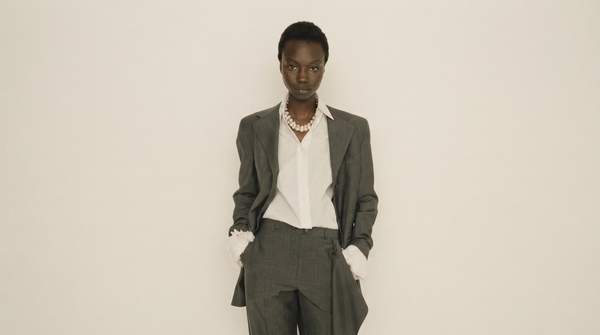
Designers at LA Fashion Week presented collections with explicit political statements, including messages referencing U.S. Immigration and Customs Enforcement (I.C.E.). These runway events, part of the city's series of showcases, occurred amid reports of significant economic disruption within the city's garment industry, creating a complex backdrop for the political fashion trends observed in Los Angeles.
Businesses in the downtown LA Fashion District experienced an 80% drop in sales following recent I.C.E. raids, according to a USC Annenberg Media report citing The L.A. Times. This severe financial consequence for a major hub of domestic apparel production coincided with the presentation of politically charged apparel on the runway, highlighting the economic pressure in the manufacturing sector.
What We Know So Far
- Designers at LA Fashion Week showcased collections featuring political commentary, including a tattered denim jacket with the words "Shatter I.C.E." spelled out, according to USC Annenberg Media.
- The Black Design Collective (BDC) was identified as the group that presented the "Shatter I.C.E." look, which was part of a deconstructed denim-on-denim ensemble, USC Annenberg Media reports.
- The BDC's presentation also included a patchwork dress that featured images of black victims, according to the same report.
- Designer Johana Hernandez presented a GLAUDI bridal collection that aimed to redefine the traditional white dress by incorporating elements of Latina heritage, masculine silhouettes, and risqué accessories.
- Businesses located in the LA Fashion District reportedly experienced an 80% drop in sales due to recent I.C.E. raids targeting workers, as reported by USC Annenberg Media.
- The Fashion District in Downtown Los Angeles is reportedly responsible for approximately 83% of all "made-in-America" clothing manufacturing, a statistic also noted by USC Annenberg Media.
LA Designer Collections Reflecting Current Politics
At the most recent LA Fashion Week, several presentations incorporated direct political messaging, moving beyond purely aesthetic statements. The Black Design Collective, for instance, featured multiple pieces addressing social and political issues. One direct example reported by USC Annenberg Media was a deconstructed denim-on-denim look, including a tattered denim jacket emblazoned with "Shatter I.C.E." The collection also contained a patchwork dress prominently displaying images of black victims, linking the apparel directly to ongoing conversations about racial justice and police brutality. These designs utilized the runway as a platform for explicit social critique and wearable commentary.
Separately, designer Johana Hernandez used her GLAUDI bridal collection to explore themes of cultural identity and tradition. Her work, described by USC Annenberg Media as a redefinition of the classic white wedding dress, was infused with elements reflecting her Latina heritage. The collection reportedly blended traditionally feminine bridal aesthetics with more masculine silhouettes and risqué accessories, an approach that challenged conventional bridal norms while celebrating cultural identity. Hernandez's show was also noted for its inclusivity, with the designer quoted as saying, "It doesn’t matter what size you are. You can do it. You can close LA Fashion Week," underscoring empowerment and representation in her collection's debut.
Economic Pressures on the LA Fashion District
The political expressions seen on the runway are set against a backdrop of significant economic challenges for the local garment industry. The LA Fashion District, a critical engine for domestic clothing production, has faced substantial disruption. According to a statistic reported by USC Annenberg Media, the district is responsible for an estimated 83% of all "made-in-America" clothing manufacturing. This concentration of production makes any disruption to its operations particularly impactful for the national apparel market, affecting the broader apparel sector.
Recent events have reportedly created such a disruption. USC Annenberg Media, citing The L.A. Times, reported that businesses in the district experienced a severe 80% drop in sales. This sharp decline was attributed in the report to recent I.C.E. raids that targeted workers in the area. The report did not specify the timeline of the raids or the sales drop, nor did it provide details on the specific businesses affected. However, the reported financial impact highlights the vulnerability of the industry's workforce and the businesses that depend on them. The connection between the industry's labor force and its economic stability is a critical factor in understanding the operational realities of fashion production in Los Angeles.
What We Know About Next Steps
At this time, the designers and collectives featured at LA Fashion Week have not publicly announced specific plans for future collections or detailed whether the political themes shown will be a recurring element in their work. Similarly, organizations representing the LA Fashion District have not released official statements or outlined specific strategies to address the 80% drop in sales reported by USC Annenberg Media. No timeline has been provided for any potential industry-wide response to the economic pressures cited. Many questions remain regarding how these events will influence future Los Angeles political fashion trends and the operational stability of its vital garment sector.