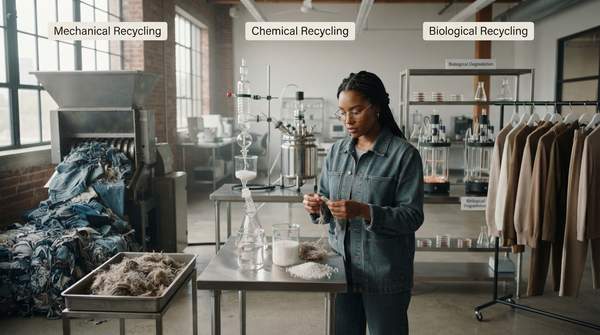
Textile recycling today rests on three distinct technologies—mechanical, chemical, and biological—and the right one depends entirely on what a garment is made of. Mechanical recycling is mature and cheap but weakens fibers. Chemical recycling can rebuild fibers to near-virgin quality but is complex, energy-intensive, and struggles with blends. Biological recycling, the newest entrant, uses enzymes and fungi to selectively separate blended fabrics that defeat the other two methods. Understanding these trade-offs is the key to judging any "circular fashion" claim.
The Imperative for Textile Recycling in Ethical Fashion
The scale of the problem is staggering. A peer-reviewed review of fiber recycling technologies reports that over 92 million tons of textile waste are generated worldwide each year, most of it landfilled or incinerated, with only a small proportion recycled. That waste stream is the raw material a circular fashion economy would depend on.
What makes the challenge hard is the material itself. Modern garments are rarely made of a single fiber; blends of cotton and polyester dominate fast fashion, and those intricate combinations are precisely what current recycling techniques most often fail to process. Any credible path to circularity has to solve both halves of the equation: turning waste into fiber, and doing so for the blended fabrics that actually fill our closets.
Mechanical Recycling: The Foundational Approach
Mechanical recycling is the elder statesman of the field. According to the U.S. Government Accountability Office, these technologies have existed since the Industrial Revolution, and the academic review characterizes the method as mature and cost-effective. It works by physically shredding textile waste and re-spinning it into new yarn—no chemistry, no molecular intervention.
Its weaknesses mirror its age. The shredding process weakens fibers, so output quality drops and the material is often downcycled into lower-value products rather than returned to clothing. More importantly, the GAO notes that mechanical recycling is limited by the modern prevalence of blended materials: a shredder cannot tell cotton from polyester, so a poly-cotton tee largely defeats it. It remains best suited to single-fiber inputs.
Chemical Recycling: Restoring Fiber Quality
Chemical recycling takes the opposite approach: instead of cutting fibers apart, it dissolves them down to their basic molecular building blocks and rebuilds them into new fiber. The payoff is quality. The review finds chemical recycling can produce high-purity raw materials, yielding regenerated fibers with properties close to virgin fibers—potentially closing the loop that mechanical recycling leaves open.
The catch is complexity. The process is energy-intensive, and the required chemical solution differs depending on the textile material. As the GAO explains, that specificity means current chemical methods are typically not effective for blended materials, since efficiently separating components within a blended fabric remains a significant challenge. The agency also notes chemical textile recycling is not currently available for widespread use, having succeeded mainly in laboratory and small-scale settings.
Biological Recycling: A Novel Solution for Complex Blends
Biological recycling offers a solution for complex textile blends. While mechanical methods shred indiscriminately and chemical methods often require single-material input, biological separation utilizes microorganisms. Specific enzymes, such as cellulases for cellulose-based materials like cotton fibers and proteases for protein-based materials like wool and silk, are employed to break down targeted fiber types within mixed textile waste, facilitating their separation and recycling.
The GAO points to the same frontier: novel approaches using enzymes can separate some blended materials, with certain enzymes able to separate cotton and polyester at the molecular level before the fibers are reprocessed into usable material. This targeted approach minimizes collateral damage to desired materials, resulting in purer recycled fibers compared to traditional methods. It is the most promising answer yet to the blend problem that stalls the other two technologies.
Comparative Overview of Textile Recycling Technologies
The table below juxtaposes the three technologies against the factors that matter most for circularity: what they can process, what quality they deliver, and where they fall short. Read it as a matching tool—a 100% cotton garment and a poly-cotton blend point to very different technologies.
| Dimension | Mechanical | Chemical | Biological |
|---|---|---|---|
| Process | Physical shredding and re-spinning of textile waste; mature since the Industrial Revolution | Reduction to basic molecular building blocks via chemical solutions, then rebuilding into fiber | Targeted biodegradation using enzymes and fungi that selectively break down specific fibers |
| Suitable fibers | Primarily single-fiber materials; limited by extensive use of blends | Requires different solutions per material; typically not effective for blends without novel approaches | Designed for blends—separates cotton from polyester, wool from nylon, and other combinations |
| Output quality | Reduced fiber quality; often downcycled | High-purity raw materials; fibers close to virgin quality | Purer recycled fibers than traditional methods, thanks to selective breakdown |
| Key advantage | Mature and cost-effective | Virgin-equivalent fiber quality | Precise, sustainable segregation of complex blends |
| Key disadvantage | Weakened fibers; cannot handle intricate blends | Complex, energy-intensive; not yet available at widespread scale | Emerging approach; scalable, low-cost solutions still needed |
Beyond Technology: Overcoming Scalability Challenges
Here is the uncomfortable finding from both the GAO and the academic literature: the barriers to circular fashion are not primarily technological. Chemical and biological methods work in the lab; what they lack is a system to feed them. Sorting is a prerequisite for recycling, yet high-speed automated sorting systems are still under development—infrared scanners that could identify textile composition are a promising but unfinished piece of the puzzle.
Collection and identification are equally weak links. The GAO notes that improved labeling detailing composition, production process, and recyclability could help address the blend problem but is not widely implemented. And even perfectly sorted waste must compete on price: the academic review frames the challenge as needing scalable, reasonably priced solutions for varied waste streams, which in practice means investment and policy that make recycled fibers commercially competitive with virgin materials. Consumer behavior—shifting fast-fashion buying patterns—rounds out the picture.
Towards a Truly Circular Fashion Economy
Achieving widespread textile recycling requires integrated efforts across technological innovation, infrastructure development, and supportive policy frameworks. No single method wins outright: mechanical recycling handles clean single-fiber streams today, chemical recycling offers the quality ceiling, and biological methods are the emerging key to the blends that dominate the waste stream. The three are complements, not competitors.
The measurable indicators to watch are concrete: increased investment in automated sorting systems, implementation of comprehensive labeling standards, and policies that make recycled fibers commercially competitive with virgin materials. When those three move, the 92-million-ton annual waste stream stops being a liability and becomes the industry's raw material.