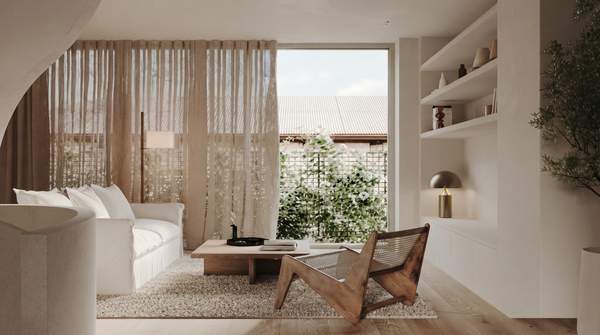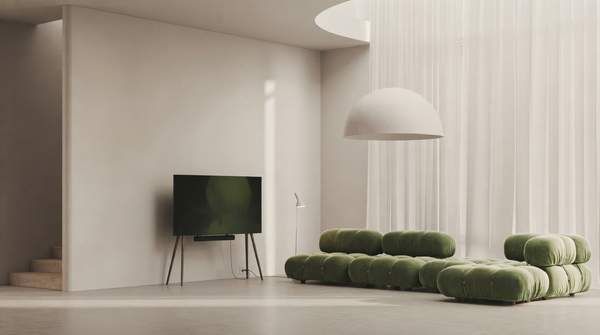
You do not need to own a building or gut a unit to live more sustainably. Within an ordinary rented apartment, three principles carry most of the weight: use energy and space efficiently, bring nature indoors, and choose materials with their full lifecycle in mind. Sustainable housing, as defined by Georgetown's Steers Global Real Assets program, is simply living space designed and operated to minimize environmental impact while promoting occupant health — and much of that can be achieved from the inside of an existing unit.
Embracing Sustainable Urban Living: A Minimalist Approach
Minimalism and sustainability converge on one idea: doing more with less. A paper by Shlok Rastogi in the International Journal of Law Management & Humanities describes sustainable design as "the efficient use of space, energy, and materials without sacrificing comfort and function." That framing suits apartment dwellers well, because a renter's leverage lies not in structural change but in how a finite space is arranged, lit, ventilated, and furnished. Fewer, better-chosen possessions also mean less furniture scrap — a point emphasized in a life-cycle assessment study of interior design by M. Kamakshi Kanchana, which notes that frequent interior overhauls generate environmentally harmful waste. The minimalist instinct to keep and reuse is itself a sustainability strategy.
Principle 1: Maximizing Energy and Resource Efficiency
The first principle is to reduce how much energy your home demands before worrying about where that energy comes from. Rastogi's paper points to biomimicry — buildings modeled on natural systems — citing Harare's Eastgate Centre, which uses natural ventilation modeled on termite mounds instead of air conditioning. An apartment cannot rebuild its ventilation stack, but the underlying logic applies: work with airflow and sunlight rather than against them. Open windows on opposite sides to create cross-ventilation, and arrange furniture so it does not block light or air paths.
Where you cannot change the building, you can change its surfaces. Wikipedia's overview of sustainable living notes that highly reflective roof materials such as aluminum increase a roof's albedo, reducing absorbed heat and the energy needed for cooling. A renter's equivalent is lighter-colored curtains, blinds, and balcony surfaces that reflect rather than store heat. The same source describes green roofs as effective thermal insulators that also catch storm-water runoff and reduce the urban heat island effect — a concept that scales down to a planted balcony.
Principle 2: Integrating Biophilic and Green Elements
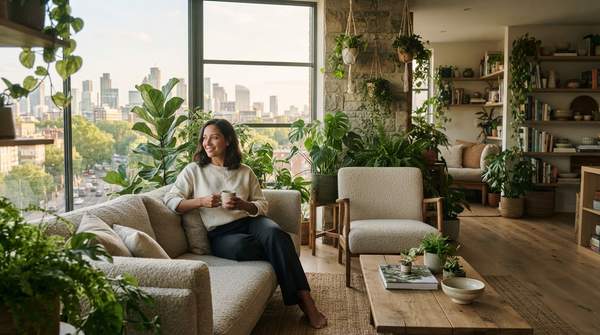
The second principle is reconnecting an interior with the natural systems that regulate it. Rastogi's paper states directly that "indoor plants and green design practices create healthier indoor environments and provide natural cooling," and that trees and shrubs planted around residential spaces absorb and block heat from the sun. In an apartment, that translates to houseplants chosen for the conditions you actually have, and balcony or window-box planting that shades glass during the hottest part of the day.
The same source observes that traditional knowledge systems, including the principles of Vastu Shastra, address building orientation, airflow, and sun exposure — the same variables that determine whether an apartment regulates temperature naturally or leans on mechanical cooling. You cannot reorient a building, but you can shift where you sit, sleep, and work within it to take advantage of morning light and prevailing breezes. The payoff is twofold: less energy consumed and a documented link between green interiors and healthier environments.
Principle 3: Conscious Material Choices for a Healthier Home
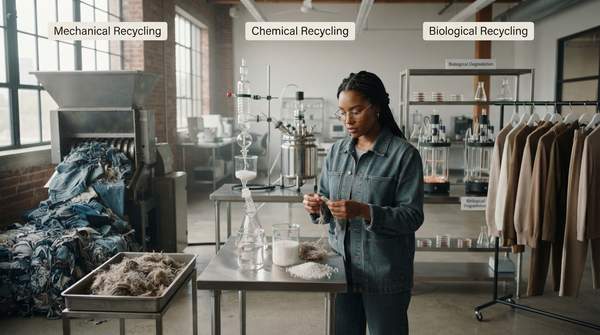
The third principle is the most consequential for a home's long-term footprint, because interior finishes recur. A guide from Goodrich Global, a flooring and wallcoverings firm, explains that interior finishes — flooring, wallcoverings, fabrics, and ceiling materials — account for a significant share of a building's embodied carbon and resource consumption, and that their shorter replacement cycles mean those impacts recur more frequently than structural ones. Kanchana's research argues the design philosophy must shift from a "now and here" approach to a holistic one that considers a product's life cycle assessment, including end-of-life management.
In practice, that means favoring durable, reclaimable, and low-emission materials — reclaimed wood over new, low-VOC paints and finishes over conventional ones — and looking for documentation rather than marketing claims. Ecochain, a sustainability software firm, recommends prioritizing manufacturer-specific Environmental Product Declarations over generic industry averages, because they offer more precise data on sourcing, production, and transportation.
Sustainable Choices for Your Urban Apartment: A Decision Framework
Use the matrix below to weigh a candidate purchase or design change against environmental impact, health effects, and renter practicality. A choice that scores well on all three is worth making soon; one that fails the practicality column may need to wait until you own your space.
| Design choice | Environmental impact | Health & well-being | Practicality for renters |
|---|---|---|---|
| Flooring (e.g., reclaimed wood) | Lower embodied carbon than new material; supports end-of-life reuse, per Kanchana's LCA research | Durable, longer replacement cycle reduces recurring impacts | Often feasible as removable panels or rugs; check lease terms |
| Paints and finishes (low-VOC) | Lower impact when chosen with lifecycle data | Better indoor air quality, fewer irritations | Highly feasible; reversible with repainting |
| Lighting and window treatments | Maximizing natural light and ventilation cuts reliance on artificial systems, per Rastogi and Georgetown's overview | Daylight and airflow support comfort and well-being | Very high; no structural change needed |
| Indoor plants and balcony greenery | Natural cooling reduces cooling energy; green roofs catch storm-water runoff, per Wikipedia's sustainable living overview | Directly linked to healthier indoor environments and natural cooling, per Rastogi | Very high; fully removable |
| Any finish with an EPD | Manufacturer-specific EPDs give precise sourcing and production data, per Ecochain | Transparency enables healthier choices | Applies at point of purchase; no installation constraint |
The reasoning path is straightforward: interior finishes drive recurring embodied carbon, so each row is evaluated first on whether it lowers that recurring burden, then on whether it improves the air and comfort you experience daily, and finally on whether a renter can actually install and remove it. Choices that pass all three tests — plants, daylight management, low-VOC finishes, EPD-documented materials — are where an apartment dweller's leverage is greatest.
Your Path to a Healthier, Eco-Conscious Urban Home
Readers should prioritize implementing energy-saving habits, incorporating natural elements, and making informed material choices based on lifecycle impacts to transform their urban apartment into a more sustainable and healthier living space. Start with the reversible, high-leverage moves: rearrange for airflow and daylight, add plants, and specify low-VOC finishes and EPD-documented materials the next time something needs replacing. The measurable indicators are concrete: reduced utility bills, improved indoor air quality such as fewer respiratory irritations, an increased sense of well-being from natural elements, and a conscious shift in purchasing decisions for home goods. None of this requires new construction — only a more deliberate way of inhabiting the space you already have.
Sources
- What is Sustainable Housing? - Steers Global Real Assets
- Adopting a Minimalist Lifestyle: An Approach to Sustainable Living — International Journal of Law Management & Humanities
- Interior Design Approach with Consideration of Life Cycle Assessment of Furniture – IJERT
- Sustainable living - Wikipedia — EN
- Life Cycle Assessment for Interior Materials Guide — Goodrich Global
- LCA Building: A Guide to Sustainable Practices — Ecochain