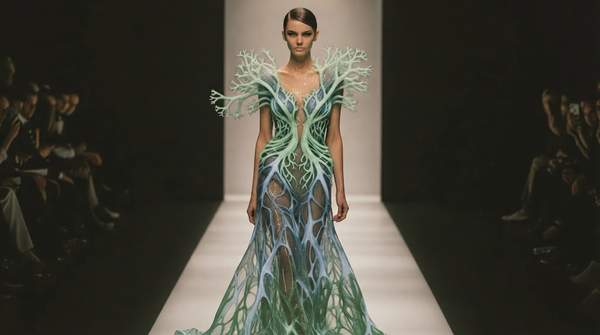
To solve some of fashion's most pressing sustainability challenges, from water pollution to textile waste, designers and innovators are increasingly looking to a powerful source of inspiration: the natural world. This approach, known as biomimicry, involves emulating nature’s time-tested patterns and strategies to create more efficient and eco-friendly materials and systems. Instead of simply extracting resources from nature, biomimicry seeks to learn from its billions of years of research and development. The goal is to apply those lessons to create textiles and garments that are stronger, cleaner, and designed to integrate back into the earth’s cycles, just as organic matter does in an ecosystem.
The application of biomimicry in fashion operates on several levels, each offering a deeper integration of nature's principles. The most direct approach involves mimicking the physical form or structure of an organism to achieve a specific function. A more complex method emulates a natural process, such as how an animal creates color without pigments. The most ambitious application seeks to model the entire fashion industry on a natural ecosystem, creating a circular and regenerative system where waste is eliminated entirely by design.
Mimicking Form: Structural Inspiration from Nature
One of the most accessible forms of biomimicry involves replicating the physical structures found in nature to solve engineering and design problems. This approach focuses on understanding the relationship between a natural form and its function. A classic example, invented in 1948, is the hook-and-loop fastener known as Velcro. Its creation was a direct result of observing how the tiny hooks on burdock plant burrs allowed them to cling tenaciously to fabric and fur, providing a model for a strong, reusable fastening system.
More recently, designers have turned to the "lotus effect" to create advanced textiles. The surface of a lotus leaf, though it appears smooth, is covered in a microscopic texture that causes water to bead up and roll off, taking dirt and dust with it. By mimicking this surface morphology, manufacturers can create fabrics that are inherently water-repellent and self-cleaning. This innovation reduces the need for frequent laundering, which saves water and energy, and can eliminate the reliance on the chemical coatings often used for waterproofing, which can have negative environmental consequences.
Mimicking Process: Emulating Nature's Functional Strategies
Beyond copying physical shapes, biomimicry also involves emulating the processes nature uses to create materials and achieve specific outcomes. A key area of innovation is in coloration. Many organisms, such as butterflies and peacocks, produce brilliant, iridescent colors not from pigments but from microscopic structures on their surfaces that refract and scatter light. This phenomenon, known as structural coloration, has inspired the development of textiles that can display vibrant, shifting hues without the use of traditional dyes, which are a major source of water pollution in the textile industry.
Another process-based inspiration comes from spider silk, a material renowned for its combination of strength and flexibility. Scientists are studying the way spiders produce this remarkable fiber at ambient temperatures and with minimal energy, using proteins as their building blocks. This has led to the development of synthetic fibers that aim to replicate these properties, offering a high-performance alternative to petroleum-based materials. Emulating nature's manufacturing—which is based on growth rather than high-heat, high-pressure fabrication—provides a blueprint for a more sustainable approach to materials development that can significantly reduce the industry's ecological footprint.
Nature's Solutions: Biomimicry in Fashion
By studying the functional adaptations of plants and animals, designers can find direct solutions to common problems in textile performance and sustainability. The following table illustrates how specific natural models have inspired innovations in fashion and fabric design, connecting a natural feature to the problem it solves and its resulting application.
| Natural Model | Problem Solved | Biomimetic Application |
|---|---|---|
| Lotus Leaf | The need for frequent washing and chemical treatments to keep fabrics clean and dry. | Self-cleaning and water-repellent fabrics are created by mimicking the microscopic surface structure of the lotus leaf, which causes water and dirt to bead up and roll off. |
| Burdock Plant | The need for a strong, reusable, and easily operated fastening mechanism. | The hook-and-loop fastener, widely known as Velcro, was directly inspired by the tiny hooks on burdock burrs that allow them to cling to fabric and fur. |
| Butterfly Wings | Water pollution and high resource consumption associated with conventional textile dyeing. | Textiles are being developed that create vibrant, shifting colors through structural coloration, mimicking how microscopic structures on butterfly wings scatter light, thereby eliminating the need for chemical dyes. |
Systemic Biomimicry: Designing a Circular Fashion Ecosystem
The most profound application of biomimicry in fashion extends beyond individual products to redesigning the entire industrial system. The Biomimicry Institute proposes a regenerative fashion system modeled after a natural ecosystem, where the concept of waste does not exist. The central problem with the current model is that synthetic fibers like polyester, which dominate modern clothing, do not biodegrade. Instead, they break down into polluting microfibers that accumulate in soil, water, and even our bodies. The institute notes that our man-made material loops inevitably leak, and the fashion industry currently lacks the "decomposers"—like bacteria and fungi—that are essential to nature's circularity.
In a healthy ecosystem, decomposition is the engine of regeneration. The Biomimicry Institute explains this vital role: "This process is crucial for maintaining the flow of life, transforming everything from fallen leaves to perished animals into valuable nutrients for new growth." To create a truly sustainable fashion industry, materials must be designed to be "food for nature’s decomposers." This means creating textiles that are biocompatible and can safely reintegrate into the environment at the end of their use, becoming part of a biological cycle. This systemic approach aims to make decomposition the "missing engine" of a circular fashion economy, transforming textile waste from a persistent pollutant into a valuable resource for new life.
Towards a Regenerative Fashion Future
By learning from nature's forms, processes, and systems, biomimicry offers a comprehensive blueprint for a truly sustainable fashion industry. It moves beyond simply reducing negative impacts to creating a regenerative model where textiles and garments are designed to be part of a healthy, circular flow of materials. This approach challenges the industry to rethink not just its products, but its entire lifecycle, from material creation to end-of-life. To achieve this, designers and industry stakeholders should prioritize the adoption of biomimetic principles, particularly those focused on systemic circularity and decomposition, to address textile waste and pollution. The success of this transition will be visible through an increased development and market availability of textiles designed for biological decomposition or closed-loop material cycles.
Sources
- Inspiring Sustainable Design: Biomimicry—Using Nature’s Blueprints — VentureWell
- Biomimicry in Textile Design: How to Innovate with Nature's… — FibreGuard
- Nature of Fashion - The Biomimicry Institute
- Biomimicry in textiles: past, present and potential. An overview - PMC
- Seven fabrics inspired by nature: from the lotus leaf to butterflies and sharks — the Guardian