Fermentation is not one process but a family of them, and the difference between a jar of sauerkraut and a loaf of sourdough comes down to which microbes are at work and what they eat. When bacteria and yeasts break down food components, they create new flavors and beneficial compounds, as Stanford's nutrition education team explains. Lactic acid bacteria turn the sugars in cabbage into sour, tangy kraut; yeasts turn the sugars in grain into ethanol and carbon dioxide that leaven bread. Understanding which microbe acts on which ingredient lets you predict what any fermented food will taste like—and why.
The Science of Fermentation: A Microbial Transformation
At its core, food fermentation happens when microbes—bacteria and yeast—break down food components, creating new flavors and beneficial compounds. The microbes involved, sometimes called fermentation-associated microbes, vary depending on the food and the method. Some foods, like sauerkraut, rely on spontaneous microbial communities of wild microbes already present on the raw ingredients and in the environment. Others, like yogurt, use an established community of specific starter cultures to control the process.
One nuance matters here. In strict biochemistry, fermentation is defined as energy production without oxygen, and these pathways consist of glycolysis with extra reactions tacked on at the end. As Khan Academy's biology materials put it, in yeast those extra reactions make alcohol, while in your muscles they make lactic acid. But in the kitchen, the definition is looser: food fermentation can happen with or without oxygen. What unites all of it is microbial transformation—living organisms consuming components of food and leaving behind new chemistry.
This is ancient knowledge. A scientific review of fermentative foods notes that fermentation of foods and beverages has a past of at least 6,000 years and likely arose from natural, spontaneous microbial interactions. What modern science adds is the ability to name the organisms, trace the reactions, and explain the flavors.
Key Fermentation Pathways and Their Microbial Agents
Two pathways dominate the fermented foods most people eat. In lactic acid fermentation, bacteria convert sugars into lactic acid. The characteristic agents are lactic acid bacteria, including Lactobacillus bulgaricus and Streptococcus thermophilus, the two cultures that yogurt production in the United States and Europe is legally required to contain. These bacteria produce lactic acid in milk, dropping the pH and causing the milk to congeal into yogurt's characteristic texture.
In alcoholic fermentation, yeasts—most famously Saccharomyces cerevisiae—convert sugars into ethanol and carbon dioxide. While some bacteria can also produce alcohol, yeast is the characteristic agent for this pathway in food. The two processes are cousins biochemically: both are alternative glucose breakdown routes that cells use when oxygen-dependent respiration is not possible.
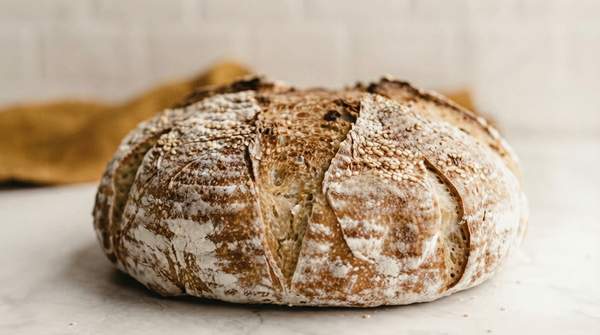
The crucial insight is that these pathways are not mutually exclusive in real foods. Sourdough is the elegant proof. Behind its simple recipe of flour and water lies a complex microbial ecosystem represented mainly by species of lactic acid bacteria and yeasts working together—a partnership that, through fermentation, gives sourdough its flavors, aromas, and shelf stability. Sourdough is neither purely lactic nor purely alcoholic; it is a mixed fermentation, which is precisely why its flavor is more complex than bread leavened with commercial yeast alone.
Comparing Major Fermentation Pathways
The table below maps the two major pathways to their microbes, raw materials, and chemical outputs. Use it to trace any fermented food backward from its taste to its biology: identify the dominant flavor compound, and you can usually infer which organisms produced it.
| Fermentation Type | Primary Microbes | Starting Ingredient (Substrate) | Key Byproducts (Metabolites) | Example Food |
|---|---|---|---|---|
| Lactic acid | Lactic acid bacteria, e.g., Lactobacillus bulgaricus, Streptococcus thermophilus; other strains contribute depending on the food | Vegetables such as cabbage; milk (sugars including glucose and lactose) | Lactic acid; in heterofermentative pathways also acetic acid and carbon dioxide | Sauerkraut; yogurt |
| Alcoholic | Yeasts, particularly Saccharomyces cerevisiae; some bacteria can also produce alcohol, but yeast is characteristic in food | Grains (flour for bread); fruits—fermentable sugars whose composition influences rate and products | Ethanol and carbon dioxide | Yeast-leavened bread; often occurs alongside lactic acid bacteria, as in sourdough |
Two qualifications keep this comparison honest. First, lactic acid bacteria split into homofermentative strains, which produce mainly lactic acid, and heterofermentative strains, which also yield acetic acid and carbon dioxide—so even within one pathway, byproducts vary. Second, many foods beyond sauerkraut and yogurt undergo lactic acid fermentation, and alcoholic fermentation frequently runs in the company of other microbes rather than alone.
From Substrate to Product: How Ingredients Shape Fermentation
The starting food—the substrate—largely determines which pathway runs and what the final product becomes. A review of fermentative foods makes this the organizing principle, noting that classification on the basis of the sources from which fermented foods originate is a productive way to understand them, and choosing classification by raw materials and final products shows the wide variety of fermented foods and the diversity of their microbiomes.
Consider three substrates. In fermented meats, the key transformation is acidification, which enhances protein coagulation—improving flavor and softness of the tissues—while drying lowers pH and water activity. In cabbage, naturally present lactic acid bacteria take over: research using 16S rRNA sequencing has shown that the sauerkraut microbiome is rapidly established after fermentation begins and remains stable through fermentation and commercial packaging. In flour and water, the substrate selects for the LAB-and-yeast ecosystem that defines sourdough.
The substrate also shapes the microbial community's origin. Sauerkraut depends on wild microbes from the cabbage and production environment; yogurt depends on deliberately introduced cultures. Same pathway, different recruitment strategy—and a different degree of control over the outcome.
The Chemistry of Flavor: Primary and Secondary Metabolites
How does a microbe eating sugar produce something delicious? The answer lies in metabolites, and they come in two tiers. Primary metabolites—like lactic acid and alcohol—help preserve food and drive the flavor profile. These are the backbone tastes: the clean sourness of kraut, the sharpness of yogurt, the warmth of ethanol. Stanford's nutrition educators note that secondary metabolites, like terpenoids, add unique flavors on top of that foundation.
This two-tier structure explains why fermentation creates complexity rather than a single note. The primary metabolite sets the dominant register, while secondary compounds layer in aromatic subtleties. In yogurt, the bacteria produce not only lactic acid but additional compounds that give yogurt its distinctive flavor. In sourdough, the combined output of lactic acid bacteria and yeasts—lactic acid, acetic acid, and ethanol—builds a flavor no single organism could produce.
Texture changes come from the same chemistry. The lactic acid that sours milk also drops its pH until proteins congeal, turning liquid milk into a gel. Flavor and structure are not separate achievements; they are consequences of the same metabolites.
Beyond Flavor: Preservation and Other Transformations
Preservation was fermentation's original job, and the mechanism is chemical warfare. During food fermentation, metabolites produced by the desirable fermenting organisms—lactic acid, acetic acid, carbon dioxide, ethanol, hydrogen peroxide, bacteriocins and antimicrobial peptides—act alone or in combination to inhibit the growth of spoilage and pathogenic organisms, extending shelf life. The lowered pH creates an environment incompatible with many harmful bacteria, as the yogurt example shows.
Acetic acid in particular functions as a natural biopreservative, causing growth inhibition of spoilage and pathogenic microorganisms. But the protection is not instantaneous or absolute. The same review cautions that fermentation takes time, providing a window of opportunity to spoilage intruders or pathogens—particularly in fresh artisan cheeses, where various Brucella strains can survive and cause foodborne illness, though they are eliminated in cheeses ripened longer than two months. By the end of a proper ripening process, most pathogens and spoilage bacteria are destroyed or permanently inactivated by the low pH, nutrient deprivation, and antibacterial substances from the fermentation flora.
One boundary worth stating: this article explains the science, not health advice. Fermented foods may contain postbiotics—non-living microbial components or metabolites—but specific health claims about probiotics are outside its scope.
Mastering Flavor Through Microbial Understanding
The practical payoff of this science is the ability to intentionally reason about microbial environments and starting ingredients to achieve desired flavor profiles and food transformations. The testable skill is this: given any fermented food, you can predict the primary microbial agents and metabolic byproducts, and identify the key flavor compounds contributing to its unique taste. Pick up a piece of sourdough and you should be able to name its LAB-and-yeast ecosystem and its lactic acid, acetic acid, and ethanol outputs; open a jar of sauerkraut and you should recognize wild lactic acid bacteria and the acid that both sours and preserves it. That prediction—microbe plus substrate equals metabolite equals flavor—is the whole science in one sentence, and it is the measurable standard for whether you have understood fermentation.