Artificial intelligence has settled into galleries, libraries, archives, and museums as three distinct kinds of tool, each with its own technology and its own payoff. The first makes collections machine-readable, turning handwritten manuscripts and uncatalogued records into searchable data. The second reconstructs damaged artifacts and lost sites as digital replicas. The third reshapes the visit itself, using interactive and gamified applications to engage audiences who once walked past the display case. Understanding which category a project belongs to—and what it is actually for—is the key to evaluating the wave of AI adoption now moving through the heritage sector.
Making Collections Machine-Readable for Research and Access
The quietest revolution is happening in the stacks. Archives and special collections hold vast quantities of material that no human team could ever fully read, describe, or index, and machine learning is changing what institutions can do with that scale. As Stacey Patton reported for the Council on Library and Information Resources, AI can generate metadata for uncatalogued collections, deduplicate information, and transcribe digitized handwritten materials—combining analysis at scale with the qualitative judgment that still requires human expertise.
Two technologies do most of the work here. Handwritten Text Recognition, or HTR, converts manuscript handwriting into machine-readable text, and the researchers Patton interviewed describe its potential as comparable to what Optical Character Recognition once did for printed books: a step change in access. Natural Language Processing then works on the results, automatically identifying people, places, and concepts in unstructured text so that records can be explored and connected in ways that manual cataloguing never allowed.
The practical benefit is that archival catalogues themselves become research objects. Patton's reporting highlights the Heritage Connector project, which used AI to build connections at scale between collection records at the Science Museum Group and other institutions—turning scattered catalogue entries into a navigable web of relationships. The tools are also becoming usable by non-specialists. Transkribus, cited in the same reporting as an example of HTR, lets users train bespoke AI models for specific document types or scripts, an approach described as especially promising for pre-modern collections where standard transcription tools fail.
Reconstructing Artifacts and Sites with AI
The second category addresses heritage that is damaged, fragile, or already gone. A scholarly review by İslam Suiçmez and colleagues, published in Smart Learning Environments, describes how AI's capabilities in data mining and object recognition enhance the analysis and documentation of museum artifacts, and—more strikingly—how AI plays a role in reconstructing the original forms of damaged artifacts and digitally recreating lost cultural items, preserving their historical value even when the physical object cannot be restored.
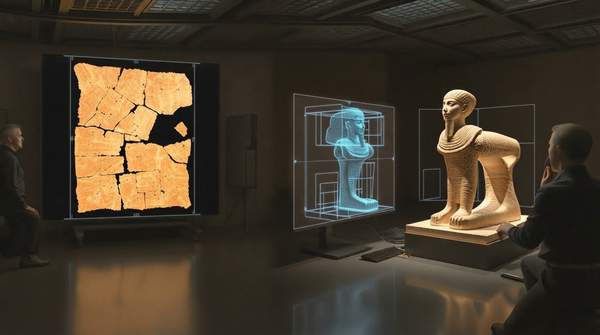
The core technology is AI-powered 3D reconstruction and modeling, which produces detailed digital replicas that can be studied, shared, and preserved without touching the original. This matters for conservation: a fragile artifact that cannot travel, be handled, or even be displayed can still exist as a research object and a public one. The review, drawing on prior work by Amato et al. from 2019, frames these digital recreations as a way of maintaining historical value that would otherwise decay with the object itself.
Reconstruction also extends to whole environments. An overview of heritage protection technologies notes that augmented reality and virtual reality have enabled the digital reconstruction of historical environments and artifacts, allowing remote exploration of cultural heritage and enhancing the visitor experience. Citing research by Boboc et al. from 2022, it records AR being applied to 3D artifact reconstruction, virtual museums, and the preservation of intangible heritage. The benefit here is double-sided: researchers gain replicas precise enough for study, while audiences gain access that transcends geographic and physical barriers. Immersive display technologies like AR and VR are the delivery layer that turns a reconstruction dataset into something a person can experience.
Enhancing Visitor Engagement and Interactive Experiences
The third category shifts the focus from the object to the person standing in front of it. The Suiçmez review describes a human-centered approach in which AI applications are designed to trigger emotions and motivate learning, positioning experiential transformation—rather than mere digitization—as the goal. Gamified museum experiences supported by AI, the authors note, citing 2025 research by Sangamuang et al., positively influence the learning processes of younger visitors.
This is also where institutional strategy is most visibly forming. The European Heritage Hub's AI-based toolkit for museums and cultural heritage sites grew out of national surveys and thematic focus groups exploring cultural trends and emerging museum needs, and its applications are strategically designed to enhance user engagement through interactive experiences. The toolkit explicitly targets small- and medium-sized institutions, aiming to help them use digital solutions to engage diverse audiences—with a focus on innovative learning experiences and interactive tools, especially for young people.
The distinction matters. Engagement-focused AI is not primarily about preservation or research throughput; its measure of success is whether a visitor notices more, stays longer, or learns something they would otherwise have missed. That makes it the most visible of the three categories and, for many institutions, the most resource-sensitive—hence the emphasis in the European toolkit on supporting smaller organizations that lack the budgets of national museums.
Comparative Overview of AI Applications in Cultural Heritage
The three categories can be distinguished by asking a single question of any AI project: what is it primarily for—processing the collection, recreating the object, or engaging the visitor? The table below sorts the documented applications accordingly, pairing each category with its core technology, its primary benefit, and a concrete example drawn from the reporting and research above.
| Application Category | Core Technology | Primary Benefit | Example |
|---|---|---|---|
| Making collections machine-readable | Handwritten Text Recognition (HTR) and Natural Language Processing (NLP) | Scalable processing, description, and exploration of archives and special collections, improving access | Transkribus, which lets users train bespoke AI models for specific document types or scripts, including pre-modern collections |
| Reconstructing artifacts and sites | AI-powered 3D reconstruction and modeling, with AR and VR as immersive delivery layers | Detailed digital replicas for study and preservation, plus remote access that transcends physical barriers | AI reconstruction of damaged artifacts' original forms and digital recreation of lost cultural items, documented in the Smart Learning Environments review |
| Enhancing visitor engagement | Interactive and gamified AI-supported applications | Human-centered experiences that trigger emotions, motivate learning, and engage diverse audiences | The European Heritage Hub's AI-based toolkit, designed to help small- and medium-sized institutions engage audiences, especially young people |
Read across the rows, the framework shows why the categories are not interchangeable. HTR and NLP serve researchers and archivists; 3D reconstruction serves both conservators and the public; engagement tools serve the visitor first. An institution choosing among them is really choosing which audience and which benefit to prioritize with limited resources.
The Ethical Weight of Digital Heritage
None of these applications is neutral. The same technologies that reconstruct a lost artifact can fabricate a plausible past that never existed, and the same data mining that connects collection records can encode bias. The heritage-protection overview warns of the risk of historical distortion, including deepfakes—digitally fabricated content presented as authentic heritage—which can undermine trust in the historical record itself. Data control and bias are companion concerns: AI trained on incomplete or skewed collections will reproduce those gaps in what it surfaces, describes, or reconstructs.
The response the sources converge on is not avoidance but governance. Responsible development, the literature suggests, depends on interdisciplinary collaboration—curators, conservators, and technologists working together rather than tools being deployed in isolation. The Suiçmez review frames AI's role as recording, transferring, preserving, and reviving cultural heritage, with digital archiving as a central element; that framing only holds if the digital record is trustworthy, which is precisely what distortion and bias threaten.
Navigating the Future: Responsible AI in Cultural Heritage
Cultural heritage institutions should strategically adopt AI tools, prioritizing interdisciplinary collaboration and ethical frameworks to maximize benefits while mitigating risks like historical distortion and data bias. The three-category framework above is the practical starting point: an institution that knows whether it is pursuing machine-readable collections, digital reconstruction, or visitor engagement can choose the right technology, define the right success measure, and scope the right ethical review.
The indicator to watch is the development and adoption of governance frameworks and counter-AI strategies within cultural heritage institutions. The European Heritage Hub's toolkit, built from surveys and focus groups and aligned with EU priorities, is one early instance of that governance taking institutional form. As more GLAM organizations formalize how they validate AI-generated descriptions, reconstructions, and visitor content, the sector's ability to capture AI's benefits without distorting the past will become measurable rather than aspirational.