Public art does more than decorate a city. Research on urban renewal describes it as one of the best means of renewing urban spaces, because it encourages belongingness, cultural identity, and community involvement. The Vancouver Biennale, an organization that places art in public space, frames public art as a driver of placemaking, social innovation, and vibrant neighborhoods—one that creates "opportunities for human connection, happiness, and wellbeing." Chengdu, in China's Sichuan province, offers a concrete illustration of how these abstract mechanisms actually operate in a living city.
The Transformative Power of Public Art in Urban Spaces
Rapid urbanization brings problems that touch ecosystems, social justice, and economics, and scholars examining public art note that its integration into cities has drawn increasing attention precisely because it addresses these pressures. Public art—understood broadly to include monuments, buildings, gardens, and community-led projects—can renew urban spaces while simultaneously cultivating the social fabric that makes a city feel like home rather than a collection of buildings.
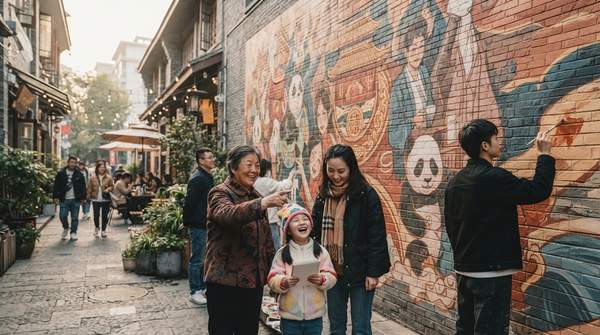
The key insight is that the artwork itself is only half the story. What matters socially is the process around it: who is invited to participate, whose culture is represented, and what conversations the work provokes. A mural is paint on a wall; a mural made with residents, reflecting their history and daily life, becomes a shared symbol. That distinction between object and process is what separates public art that merely exists from public art that builds community.
Mechanisms of Impact: How Public Art Builds Community
Three mechanisms recur across the evidence. The first is placemaking: art turns anonymous public space into a place people choose to gather, which the Vancouver Biennale identifies as central to building vibrant neighborhoods and countering loneliness. The second is cultural expression: art renders a community's identity visible, giving residents shared symbols they recognize as their own. The third is participation and dialogue: when residents help create or discuss a work, the art becomes a vehicle for conversation and co-created meaning rather than a finished object imposed from outside.
These mechanisms reinforce one another. A participatory project produces a shared symbol; the symbol draws people to a place; the place then hosts further encounters. Public art, in this reading, functions as a device for social innovation—less a luxury than an instrument for strengthening the social connections that dense urban environments tend to erode.