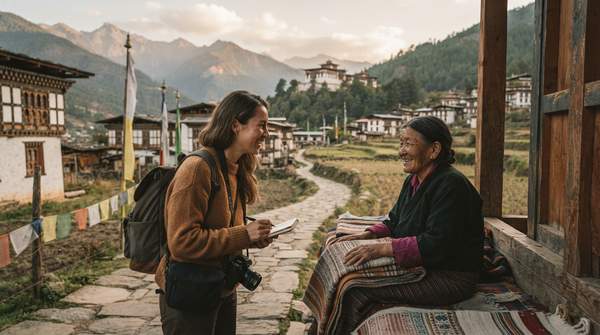
If your 2027 travel wish list is still a blank page, the strongest advice from this year's destination coverage is this: don't pick a place first — pick the kind of experience you want. The destinations now being flagged as "emerging" for 2027 are not simply beautiful or new to Instagram. They represent three distinct shifts in how travelers want to engage with the world: tourism that feeds local communities, journeys built around archaeological discovery, and deep cultural immersion in places where mass tourism has never taken hold.
Understanding Emerging Travel Trends for 2027
Travel publications have begun grouping next year's most-watched destinations by motivation rather than geography, and that grouping is more useful than any ranked list. BBC Travel's selection of the best places to travel in 2027, published in November 2026, leads with places where the draw is not a monument or a beach but a relationship — like Meghalaya, in India's north-east, chosen for discovering "living root bridges, sacred forests and mountain communities from a local homestay." Adventure operator Wild Frontiers, in its trending-destinations outlook, makes the same move with archaeology, highlighting a remote Inca citadel in southern Peru as a "new" lost city.
The third category is the least commodified: places prized precisely because their tourism infrastructure remains thin and their cultures remain dense and intact. Papua New Guinea is the standard-bearer here. Its dramatic landscapes are, in the words of destination coverage, rivalled only by its human diversity — a country home to more than 1,000 ethnic groups and over 850 languages. That is not a marketing slogan; it is a statistical portrait of one of the most culturally heterogeneous nations on Earth, and it explains why explorers describe it as one of the last "raw and authentic" travel experiences available.
What unites all three trends is a reaction against passive sightseeing. The 2027 destinations earning attention are those where the traveler's presence is structured to give something back — to a village, an ecosystem, or a fragile historical record — rather than simply to consume a view.
Community-Integrated Travel: Benefiting Local Cultures and Environments
Community-based tourism is the most concrete of the three trends, because you can see exactly where your money and time go. Meghalaya, India, is the clearest example. BBC Travel describes how "generations of Khasi villagers have guided the roots of living trees to form bridges" across the deep gorges and rivers of the lush Khasi and Jaintia hills, and notes that the state is set to become one of India's most exciting destinations for community-based travel in 2027. The living root bridges are not a construction project — they are a centuries-old collaboration between people and forest, and staying in a local homestay puts you inside that continuing relationship rather than at a scenic overlook outside it.
Nayarit, on Mexico's Pacific coast, shows the same philosophy through its artisans. Community-based tourism initiatives there are creating opportunities for visitors to engage with local culture through artisans and community members, in experiences that incorporate art, storytelling, gastronomy and traditional practices. The point, as the state's 2027 destination promotion frames it, is that these encounters "provide insight into the people and cultural traditions behind the artwork, extending the experience beyond the purchase of a handcrafted piece." You leave understanding who made what you bought and why.
Nayarit's cultural diversity carries directly into its food, which gives community-integrated travel a sensory dimension: along the coast, pescado zarandeado — grilled, marinated fish — remains one of the state's defining dishes, complemented by shrimp, oysters and ceviches drawn from Pacific waters. Gastronomy here is community culture on a plate, served by the same fishing villages that the tourism initiatives are designed to support.