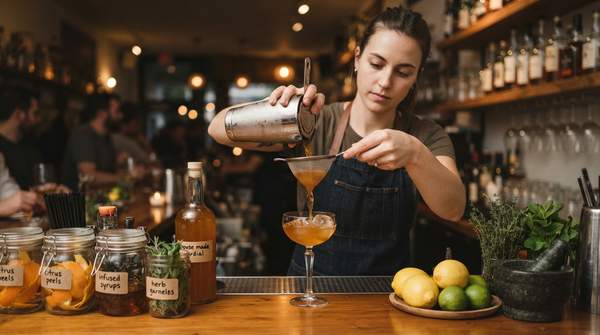
Closed-loop mixology means running your bar so that nothing is simply thrown away: every byproduct — the citrus husk, the herb stem, the spent coffee ground — is treated as the raw material for a new ingredient. The idea borrows from how nature works, as the recycling organization Bay Area Recycling for Community puts it: fallen leaves decompose and nourish the soil, and nothing goes to waste. Bartenders can apply the same logic to the cocktail bar, turning yesterday's waste into tomorrow's syrup, tincture, or garnish.
Understanding Closed-Loop Systems in Mixology
The essential shift is from a linear model to a circular one. The standard bar runs on what Bay Area Recycling for Community describes as the open-loop "use and discard" model: produce is made, used, and thrown away. A closed loop instead captures those materials and turns them into something valuable again — sometimes even the same product. The organization's account of why this matters is straightforward: closed loops prevent usable resources from being lost to landfill and reduce the need to extract fresh raw materials.
Applied to the bar, the ambition is captured by bartender Ryan Chetiyawardana, who with his partner Iain Griffiths set out to prove a "closed-loop cocktail" was possible, as reported by PUNCH — one where, in their words, every ingredient is used in its entirety either in that drink or a future one. When he opened Dandelyan in London's Mondrian Hotel, he studied his ingredients in an off-site lab specifically to discover how to use each element more completely. That mindset, not any single recipe, is the foundation.
The stakes are not decorative. Writing on drinks industry trends, Mathieu Teisseire's editors note that around 931 million tonnes of food goes to waste each year, with food service accounting for 26% of it — over a quarter of all food waste. A bar squeezing dozens of limes a night is directly implicated.
Identifying Common Bar Waste Streams for Repurposing
The first practical step is an audit: what does your bar actually discard, and what does each stream still contain? The most familiar stream is citrus. As Clinton Cawood writes for Bar Convent, citrus husks are "a classic example, produced and discarded in vast quantities to create fresh citrus juice for the majority of cocktails out there." Herb stems are a second stream, still aromatic after the leaves are gone. Spent coffee grounds retain flavor and aroma even after brewing. Used spices — peppercorns that have given up their infusion, for instance — and spent tea each leave residual character worth capturing.
The key analytical move is to ask what each stream still holds. Peels and rinds, as one zero-waste bartending overview explains, are filled with robust flavors that seep well into a sugar-and-water mixture. Fibrous stems and grounds hold subtler aromatics suited to slow infusion. Recognizing the residual value is what turns a waste problem into an ingredient inventory.