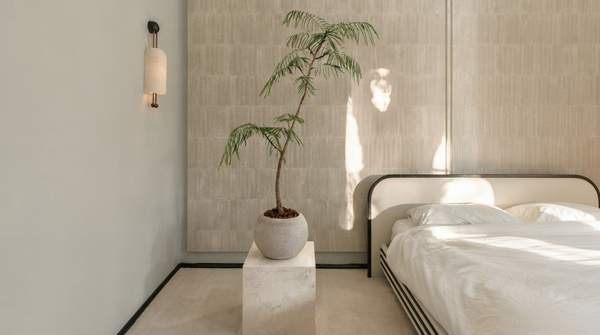
You do not need a garden, a balcony, or a landlord's permission to practice biophilic design. The framework, developed by the late Yale scholar Stephen Kellert, is a studied approach to incorporating nature into architecture and interiors that considers the whole human experience—physical, mental, and emotional needs together, as the design-build firm Tectonic describes it. For urban dwellers, the practical question is not whether biophilic design works but which interventions fit your square footage, your budget, and your lease. The answer, drawn from Kellert's six principles, is that nearly every principle can be addressed with movable, low-cost, non-permanent changes.
The Urban Biophilic Home: A Decision Framework
Kellert's six principles—environmental features, natural shapes and forms, natural patterns and processes, light and space, place-based relationships, and evolved human-nature relationships—provide what the architecture firm Neumann Monson calls a starting point for brainstorming design decisions. The trick for city residents is translating each principle into something that survives a small floor plan and a security deposit. The table below maps each principle to concrete actions, with the constraints that matter most in urban housing.
Your Urban Biophilic Design Action Plan
| Biophilic Principle | What It Means | Urban Application | Space, Cost, and Renter Considerations |
|---|---|---|---|
| Environmental Features | Direct connections to nature: plants, natural light, fresh air. | Indoor plants, orienting furniture toward windows, a small water feature. | Choose species suited to your light; vertical gardens save floor space; water features should be low-maintenance. All movable and renter-friendly. |
| Natural Shapes and Forms | Nature's curves and materials, moving beyond literal representation to abstract interpretation. | Furniture with organic curves, visible wood grain, botanical-patterned textiles. | Fit the scale of the room; natural material accents are typically renter-friendly and can be low-cost swaps. |
| Natural Patterns and Processes | Dynamic, non-rhythmic sensory stimuli—changing light, flowing water, weather. | Lighting that shifts through the day, reflective surfaces that mimic water, natural soundscapes. | Smart bulbs can simulate light cycles; sound machines need no installation. Modest cost, zero footprint. |
| Light and Space | Optimizing natural light and creating both openness and refuge. | Mirrors to amplify daylight, sheer window treatments, a cozy reading nook. | Mirrors visually expand small spaces; a defined nook creates refuge in an open-plan apartment without construction. |
| Place-Based Relationships | Connecting the home to its particular locale and landscape. | Materials, artwork, or plants native or meaningful to your region; framing a view of the local skyline or street trees. | Artwork and plant choices are inexpensive and fully portable between rentals. |
| Evolved Human-Nature Relationships | The innate human affinity for living systems—Kellert's biophilia itself. | Caring for plants, watching weather and seasons from your window, orienting a desk toward the outdoors. | Free to nearly costless; requires only habit and placement rather than purchases. |
Two rows deserve emphasis. Landscape designer Ryan Balagtas, quoted by ThinkLandscape, notes that furniture is often placed in front of windows facing inward, and that orienting furniture toward a view—or at least not obscuring it—is "a big opportunity that people often under-utilize." And even a mediocre view helps: being able to see natural processes such as rain approaching or the sun changing its angle in the sky benefits our nervous systems, according to the same reporting. Terrapin Bright Green's pattern research reaches a similar conclusion, recommending that projects improve views and bring plants into a space, with interventions as simple as orienting desks toward the outdoors.