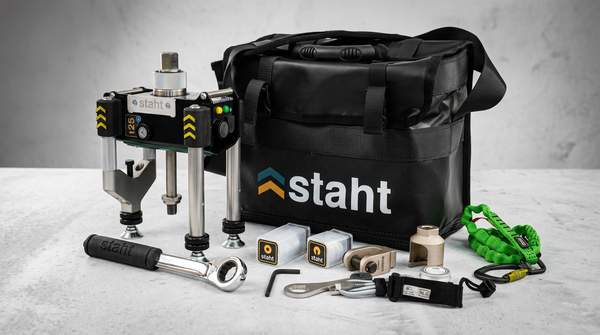
Pull testing is an important part of verifying the performance of fixings, anchors and other installed components in construction and safety-critical applications. For professionals responsible for testing on site, choosing the right equipment is about more than selecting a load capacity. The tester needs to suit the application, provide dependable measurements and make it practical to record and report results.
Modern digital pull testers can also simplify the administrative side of testing. Instead of treating measurement and documentation as separate tasks, today's equipment can combine digital readings, data logging and connectivity in one testing workflow.
For contractors, engineers, inspectors and other professionals who carry out regular pull tests, understanding the available options can make equipment selection considerably easier. Staht's range of digital pull testing equipment is designed around this combination of accurate load measurement, practical field use and digital test documentation.
Start With the Required Test Load
One of the first questions to answer when choosing a pull tester is how much load the equipment needs to measure.
Different testing applications have different requirements, so selecting equipment solely on price or physical size can lead to an unsuitable choice. The tester should provide an appropriate capacity for the tests being carried out while remaining practical for the environments in which it will be used.
Staht's t25 Digital Pull Tester provides a maximum load capacity of 25 kN, while the t60 Digital Pull Tester provides capacity up to 60 kN. This gives professionals a straightforward starting point when deciding which equipment is appropriate for their expected testing requirements.
The important consideration is not simply choosing the tester with the highest possible capacity. A professional should consider the loads specified for the particular fixing, anchor or application and select equipment accordingly.
This approach can also help businesses avoid investing in equipment that is unnecessarily large or powerful for their routine requirements.
Consider Where the Testing Will Take Place
A pull tester may be used in a workshop, on a construction site or in another working environment where portability and ease of setup matter.
Construction testing can involve awkward access, changing site conditions and a wide range of substrates and fixing arrangements. Equipment therefore needs to work as part of a practical field-testing process rather than simply providing a measurement in controlled conditions.
Staht's digital pull testers are designed for professional field use and can be used with different bridges and accessories to accommodate various testing configurations. This flexibility can be particularly useful for professionals who encounter different fixing types or testing situations across projects.
Before purchasing, it is worth considering the types of work your team carries out most often. A tester that suits one application may require different accessories or configurations for another.
Thinking about the complete testing setup at the purchasing stage can help ensure that the equipment you choose is genuinely useful once it reaches site.
Look Beyond the Load Reading
A digital display is valuable, but professional pull testing often involves more than recording a single number.
A test may need to be associated with a particular fixing, location, project or client. Depending on the application, professionals may also need to retain information about the test conditions and outcome. If those details are recorded manually, there is greater scope for administrative work after the testing itself has finished.
This is where digital data management becomes an important consideration when comparing pull testing equipment.
Staht Connect is designed to work with compatible Staht testers through Bluetooth connectivity. The system can capture test information including peak load, target load, pass/fail result, timestamp, notes and location information. Users can also add photographs and video to help document the test.
For businesses carrying out multiple tests, this can turn the testing process into a more structured digital workflow.
Rather than viewing the tester simply as a device that measures force, it can become part of a wider system for collecting and managing test information.
Make Reporting Part of the Equipment Decision
Testing is only one part of the process. Once testing is complete, results often need to be communicated to clients, project teams or other relevant parties.
A useful reporting system can reduce the amount of time spent transferring handwritten or manually recorded information into another format.
Staht Connect allows test data to be synchronised with its cloud dashboard, where information can be organised and filtered. The system can also be used to generate professional reports for sharing.
This matters particularly for businesses carrying out testing across multiple projects or locations. When test information is consistently captured and organised, it becomes easier to retrieve the details associated with previous work.
For a contractor or testing professional, that can mean spending less time reconstructing test records after returning from site and more time concentrating on the work itself.
Check Compatibility With Your Applications
Not every pull test is the same. The fixing, substrate, anchor system and required test procedure all influence how testing should be carried out.
Pull testing can be relevant to applications including scaffolding, fall protection, rope access, fixings and fasteners, lifting and rigging, curtain walling and cladding. The appropriate equipment and test arrangement will depend on the specific application.
For this reason, purchasing decisions should take the complete testing requirement into account.
Consider the types of fixings you routinely test, the loads involved, the substrates encountered and whether additional bridges or accessories are required. If your work covers several different applications, it can also be useful to look at how adaptable the equipment is.
Staht's product ecosystem includes testing equipment, bridges, adapters and other accessories intended to support different testing configurations. This allows buyers to consider the tester and its associated equipment as a complete system rather than an isolated instrument.
Don't Overlook Calibration
Calibration is another important consideration when purchasing professional testing equipment.
A pull tester needs to provide reliable measurements, and businesses should have a clear understanding of how the equipment will be maintained and calibrated throughout its working life.
Staht recommends annual calibration for its equipment, while noting that more frequent calibration may be appropriate depending on factors such as industry requirements and usage. Staht provides UK-based calibration services, including UKAS-traceable calibration certificates.
When comparing equipment, therefore, it is worth looking beyond the initial purchase price. Consider the ongoing support available, how calibration is handled and whether the manufacturer can provide the documentation your business requires.
A clear calibration process can help make equipment management more straightforward and support the record-keeping requirements associated with professional testing.
Consider Training and Ongoing Support
Even well-designed equipment needs to be used correctly.
Professionals who are new to a particular testing system may benefit from manufacturer training, particularly where the work involves multiple accessories, applications or digital reporting tools.
Staht offers training covering its equipment and Staht Connect, with practical instruction available at its Stourbridge facility and on-site training available subject to availability. This gives businesses an opportunity to develop familiarity with the equipment rather than relying entirely on trial and error.
Manufacturer support can also be useful when teams need guidance on equipment selection, accessories, testing procedures or software features.
For businesses investing in testing equipment as part of an ongoing service, these factors can be just as relevant as the specifications printed on the product sheet.
Choosing Between the Staht t25 and t60
For professionals considering Staht's digital pull testers, the t25 and t60 provide two clear capacity options.
The t25 offers testing up to 25 kN and may be appropriate where routine testing requirements fall within that capacity. The t60 extends capacity to 60 kN for applications requiring higher loads.
The right choice depends on the requirements of the work rather than simply choosing the larger model. Buyers should consider the loads specified by the relevant application or testing requirements, along with the accessibility, portability and accessories needed for their work.
Both models are part of Staht's connected digital testing approach, giving users access to Bluetooth-enabled data capture through Staht Connect.
For businesses expecting their testing requirements to vary between projects, it is also worth considering which model and accessory combination provides the flexibility needed for their typical workload.
A Pull Tester Should Support the Whole Testing Workflow
The best purchasing decisions begin by looking at the complete process.
How will the equipment be transported? What loads need to be tested? Which fixings and substrates will be encountered? What accessories will be needed? How will results be recorded? How will reports be produced? How will the equipment be calibrated?
Answering these questions can help identify the right testing system before making an investment.
Staht's approach brings digital load measurement together with Bluetooth connectivity, data logging and reporting through Staht Connect. Its range of testers and accessories is designed for professional applications across construction, safety and related testing environments.
For organisations that carry out regular pull testing, that combination can provide a more integrated approach to field testing and documentation.
Choosing a digital pull tester is therefore not simply a matter of finding a device that reaches the required load. It is about selecting equipment that fits the application, supports accurate testing and makes the resulting information practical to manage.
For professionals looking to build a reliable pull-testing process, exploring the Staht t25, t60 and associated testing equipment is a useful starting point. With the appropriate capacity, accessories, calibration and digital reporting tools, the right testing system can become a practical part of a professional team's day-to-day workflow.